“That’s when it hit us: maybe, just maybe, some issues are random or even… self-inflicted?”
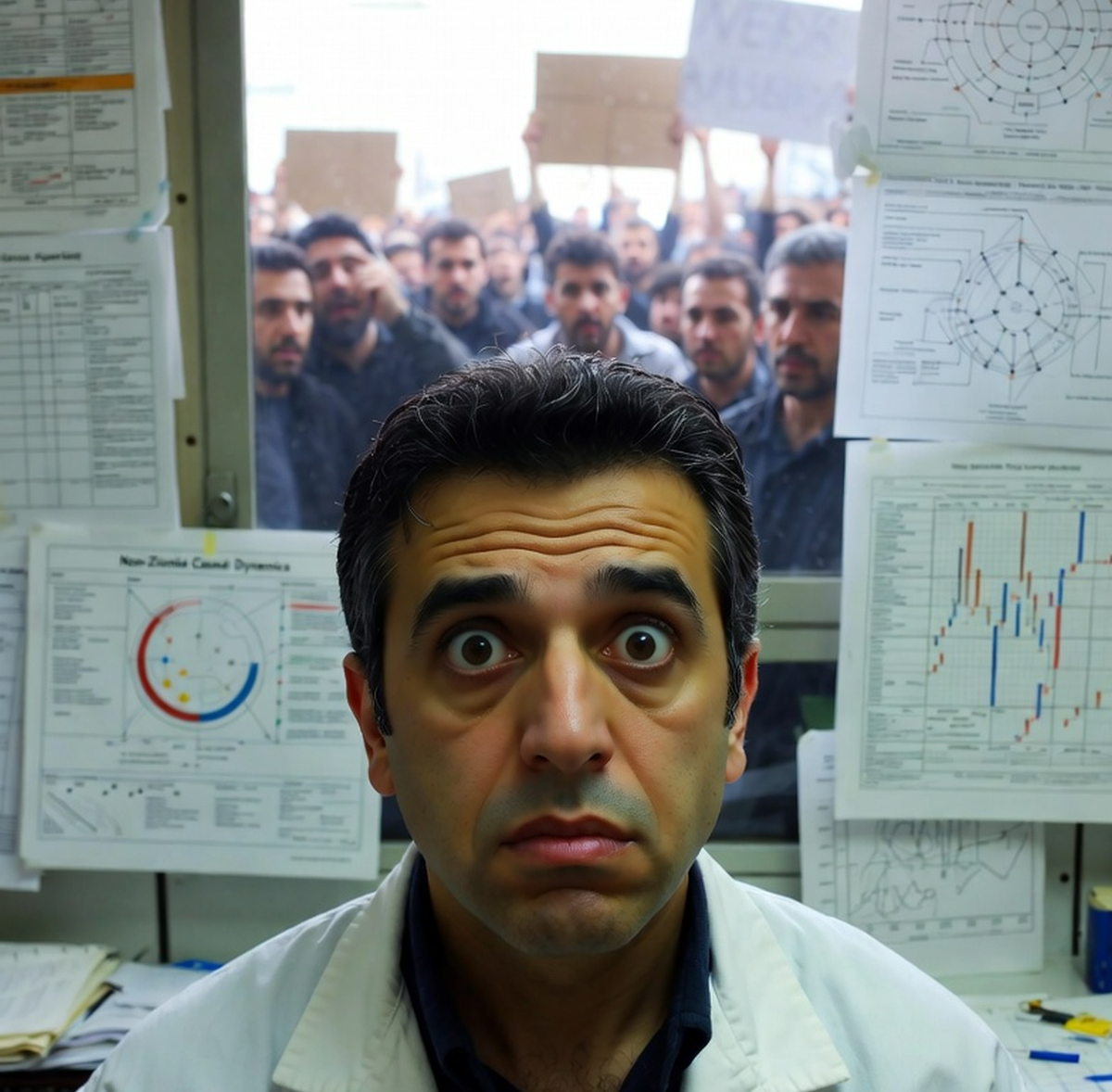
Beirut, January 6 – Audacious recent research has prompted Middle East scientists to consider – tentatively – a notion inconceivable in the region only a few years ago: that at least some problems stem not from evil machinations of “Zionists,” but from other, still-ill-defined factors or forces. The idea carries implications that could resonate in academia, politics, defense, economics, and myriad other fields, with the potential to transform each one – and possibly all of society in the process.
The groundbreaking paper, published in the journal Regional Conspiracy Quarterly, was authored by a team led by Dr. Ahmed Al-Fikri, a physicist at the University of Beirut known for his work on quantum blame attribution. “We’ve always assumed that every setback—from traffic jams in Cairo to poor Wi-Fi in Damascus—could be traced back to a shadowy cabal in Tel Aviv,” Al-Fikri explained in an exclusive interview. “It didn’t begin and end with Israel opening nonexistent dams every winter to flood Gaza. But our models kept crashing when we tried to input real-world data. That’s when it hit us: maybe, just maybe, some issues are random or even… self-inflicted?”
The theory, dubbed “Non-Zionist Causal Dynamics” (NZCD), posits that phenomena such as economic stagnation, political corruption, and even bad weather might arise from sources such as poor governance, outdated infrastructure, or climate change. Early simulations using NZCD have yielded startling results: applying the model to the 2023 Lebanese banking crisis revealed that only 47% of the blame could plausibly be assigned to “Zionist plots,” leaving a whopping 53% attributable to fiscal mismanagement and global market fluctuations. “It’s revolutionary,” said co-author Dr. Layla Hassan, an economist specializing in scapegoat economics. “We’re talking about freeing up cognitive resources that have been tied up in elaborate confirmation biases for generations.”
Skeptics remain. Iranian state media dismissed the research as “a Zionist ploy to deflect blame.” A spokesperson for the Revolutionary Guard quipped, “If it’s not the Jews, then who? The Martians?” Similar sentiments echoed in Damascus and Baghdad, where street protests erupted—not against the theory itself, but against the audacity of suggesting that local leaders might bear some responsibility. One protester in Amman held a sign reading, “Blame Ourselves? That’s What They Want Us to Think!”
Despite the backlash, the implications of NZCD are profound. In academia, it could lead to new curricula that teach critical thinking without defaulting to antisemitic tropes. Politically, leaders might have to address real issues like education reform or environmental policies instead of rallying crowds with anti-Israel rhetoric. Defense strategists are particularly intrigued: if military setbacks aren’t always due to “nefarious Zionist treachery,” then perhaps investing in training and equipment could yield better results.
Economists posit a boom in sectors previously stifled by blame-shifting. “Imagine redirecting funds from propaganda ministries to actual development,” mused Dr. Hassan. “We could build roads that don’t collapse because of ‘sabotage’ but because we finally fix the potholes ourselves.” Socially, the model suggests a path to reduced tensions, fostering dialogues based on mutual accountability rather than eternal victimhood – an unprecedented, countercultural paradigm that challenges the very foundations of regional thinking.
The researchers foresee numerous significant hurdles. Focus groups have met with confusion. In one Jordanian hamlet, residents were asked to attribute a failed harvest to natural drought rather than “Zionist weather machines.” “But why would the drought happen if not for them?” one farmer asked, encapsulating the cognitive challenge facing the new model.
Al-Fikri remains optimistic. “This is just the beginning. Our next paper explores the radical idea that peace might not require the annihilation of an entire people.”
Please support our work through Patreon.
Buy In The Biblical Sense: https://www.amazon.com/dp/B0B92QYWSL



 Fabulous Facebook Comments!
 Glorious Google+ Comments!
 Wordpress Comments